



Special Correspondent: Lee Kuan Yew the founder of modern Singapore and its former prime minister, once said that drug is the mother of all crimes. He believed that simply by stopping drugs, it is possible to build a safe and crime-free Singapore. With this objective in mind, under his leadership, the “Misuse of Drugs Act” was enacted in 1973, which introduced the death penalty for possessing more than a specified quantity of drugs or for drug trafficking. Despite criticism from various international quarters, he vigorously defended this law as indispensable for the nation’s security. The Central Narcotics Bureau (CNB) was granted extensive powers, enabling them to conduct anti-drug operations, random searches, and strict surveillance at any time. It is due to Lee Kuan Yew’s zero-tolerance policy that Singapore has come to be known as one of the most drug-free countries in the world. And because it was liberated from the curse of drugs, crime in Singapore has decreased significantly. Today, Singapore is recognised as one of the safest countries in the world.
A world vocal against drugs
Although the Western world initially criticised Lee Kuan Yew’s strict stance, most countries around the globe have now chosen this path to rid themselves of the aggression of drugs. In Malaysia, being caught selling drugs can carry the death penalty. The country also enforces imprisonment and fines for drug possession. Furthermore, if immigrants are found with drugs, they may be deported. On the other hand, drug trafficking in Thailand can result in the death penalty. In Saudi Arabia, the death penalty is almost certain if caught selling drugs. For consuming or possessing drugs, the country inflicts public flogging, fines, and long-term imprisonment. Similar provisions exist in Kuwait, Qatar, and other Middle Eastern countries.
In Indonesia, convicted drug dealers can face the death penalty. In the summer of 1971, US President Richard Nixon declared drugs as “public enemy number one” and launched a campaign against them, which later became known as the “War on Drugs.” This policy pledged to rid American streets of drugs, smash trafficking networks, and create a safe environment for US citizens. The United States can conduct anti-drug operations not only within its own borders but also in any country around the world. Recently, as part of this war on drugs, the president of Venezuela was detained and is facing trial in the United States.
The former president of the Philippines, Rodrigo Duterte, drew widespread criticism for his country’s war on drugs. However, even though his controversial campaign was criticised worldwide, it halted the unchecked spread of drugs in the Philippines. Duterte served multiple terms as the City Mayor of Davao before becoming the President of the Philippines. He served as president from 2016 to 2022. During his tenure as both mayor and president, Duterte waged a war against drugs. Numerous people were extrajudicially killed in the name of this alleged war on drugs. Last year, Duterte was arrested in Manila, the capital of the Philippines. On the same day, he was sent to the ICC in The Hague, the Netherlands. The 79-year-old Duterte is now facing trial in this court. Nevertheless, the people of that country still express gratitude toward Duterte for liberating them from drugs.
The situation in Bangladesh
The countries in the world that have managed to escape the deadly clutches of drugs have all done so by enacting strict laws and enforcing them impartially. However, although Bangladesh has strict laws against drugs, there is a lack of enforcement. As a result, Bangladesh has become a safe haven for drug dealers. An unchecked proliferation of drugs is ongoing across the country. From children and teenagers to the elderly, people are falling into drug addiction today. Drugs are destroying the working capacity, creativity, and moral values of the country’s population. It is making people violent and brutal. We are now witnessing the realistic proof of what Singapore’s founder Lee Kuan Yew said—that drugs are the source of all crimes—right here in Bangladesh. Due to drugs, incidents of rape and violence against women are on the rise. Along with drugs, crimes like murder, mugging, and robbery are expanding. Due to the free movement of drugs, a roaring trade in illegal weapons is thriving. Relying on drug syndicates, smuggling and human trafficking rings have also emerged. The “Kishore Gang” (juvenile gangs) has become the biggest social malady today, and the primary reason behind this is the unchecked spread of drugs. Crime analysts say that ninety percent of various crimes in the country originate from drugs. Experts believe that if drug smuggling and its unchecked spread can be stopped, the crime rate in Bangladesh will drop significantly.
Why Bangladesh is failing in the war on drugs
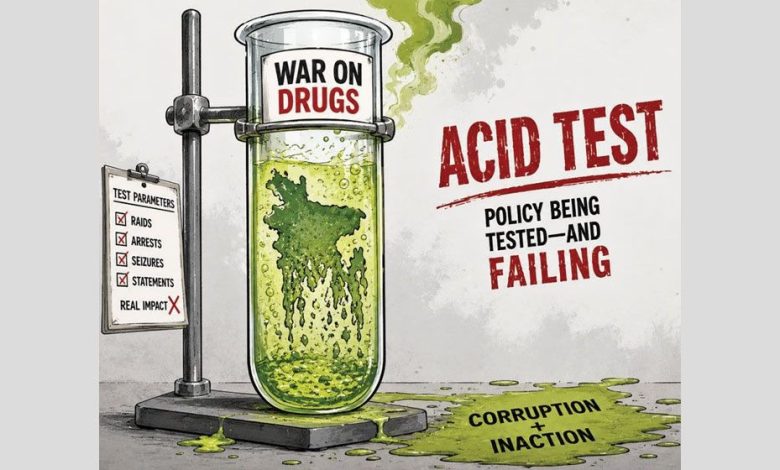
In Bangladesh, every government assumes office and declares a strict stance against drugs, but in reality, the drug syndicates are never shut down. In the past, we have seen recognised drug dealers even becoming members of the National Parliament. After the current government took office, Prime Minister Tarique Rahman announced a zero-tolerance position against drugs. He instructed the home minister to conduct anti-drug drives. In light of the prime minister’s directives, the Ministry of Home Affairs has launched nationwide anti-drug operations. Recently, the home minister said in Parliament that from 17 February to 31 May, 30,744 anti-drug drives were conducted across the country, resulting in 9,251 cases filed and 9,685 drug traffickers arrested and brought to justice. The home minister added that a list of drug dealers is being prepared to curb the spread of drugs. However, a list of drug dealers had already been prepared. Notably, in 2023, a Division Bench of the High Court Division of the Supreme Court of Bangladesh ordered the government to submit a list containing the names and addresses of the country’s top drug lords. Following that directive, a list of 3,000 drug dealers was prepared. But for unknown reasons, that list was never presented to the court. A source from the Ministry of Home Affairs revealed that a list of 292 godfathers and four thousand top drug dealers has been finalised. The Ministry of Home Affairs is taking action according to this list. The IG of police stated that anti-drug operations are a top priority for the police, and law enforcement agencies across the country have been kept on high alert regarding this matter.
However, these statements do not align with reality. On 22 June, a report titled “Silent Spread of New Drugs” in the daily KalerKantho said: “Alongside conventional drugs, a diverse range of new-generation drugs has spread somewhat silently across the country. Among these, synthetic or artificial drugs are more familiar to the new generation. The form and composition of these new drugs have changed into MDMB, Ice, Khat, LSD, Fentanyl, Black Cocain, MDMA, DMT, DOB, Magic Mushroom, Kush, Tapentadol, Tramadol, and Ketamine.” Doctors fear that if these new types of drugs are not controlled immediately, an entire generation will be destroyed.
What Bangladesh needs to do
The spread of drugs cannot be contained in Bangladesh due to various reasons. The cases filed against drugs do not ultimately hold up in court. Drug dealers and criminals exploit legal loopholes to walk free. In law, the maximum punishment for drug trafficking is the death penalty. However, this provision for the highest punishment exists only on paper, not in reality. In most cases, the accused secure bail and walk out. The police claim that proper trial of the cases is not possible due to a lack of witnesses.
Law alone is not enough in the war on drugs; social awareness is crucial. A culture of hatred against drugs needs to be established socially. The government has made dope tests mandatory for drivers, but even there, the law is not being properly enforced. Although dope tests were supposed to be mandatory for entering government jobs, it has not been implemented yet. Experts believe that dope tests should be made mandatory in every sector, from university admission onwards. This will strengthen the social movement against drugs.
In the past, it has been observed that drug dealers and godfathers take shelter under the wings of whichever political party comes to power. As a result, no action can be taken against them. Political consensus is required in this regard. All political parties must pledge that they will not shelter drug smugglers and drug godfathers. If political patronage is eliminated, it will be easier to take strict action against drugs. The war on drugs is an acid test for this government.
Political parties have a vital role to play in building a drug-free Bangladesh. The government and the opposition must take a united stance on this issue in the National Parliament. Political parties must realise that no sustainable development is possible for the country unless it is freed from the devastating clutches of drugs. If the abuse of drugs cannot be stopped, this nation will be ruined. We have no alternative but to win the war on drugs.


