
Dr. Zubaida Rahman Joins UN Resident Coordinator’s Office
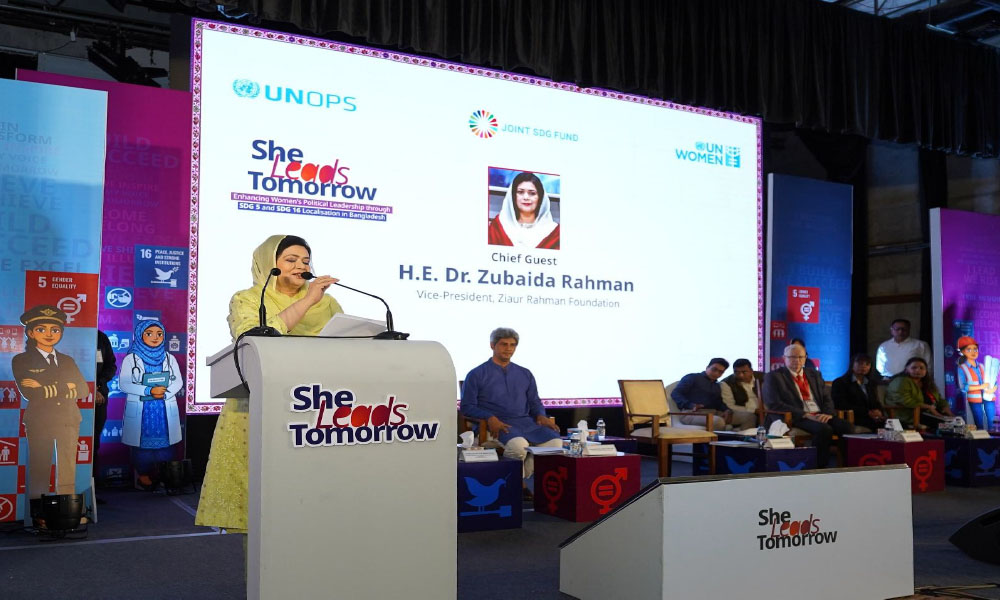 Staff Reporter: The United Nations Resident Coordinator's Office, UN Women and UNOPS Bangladesh, jointly celebrated the leadership, resilience and aspirations of the next generation of women leaders through "She Leads Tomorrow," the National Dissemination Event of the project
"Enhancing Women's Political Leadership through SDG 5 and SDG 16 Localisation in Bangladesh," held today at the Liberation War Museum in Dhaka. Supported by the Joint SDG Fund. The initiative has empowered more than 1,000 adolescent girls and young women to become leaders and changemakers in their communities. The event brought together senior government officials, Members of Parliament, diplomats, United Nations representatives, development partners, civil society leaders, academics, media personalities and young women leaders to celebrate the project's achievements and discuss the future of women's political leadership and inclusive governance in Bangladesh.
The event was graced by Dr. Zubaida Rahman, Vice-President of the Ziaur Rahman Foundation, as the Chief Guest. Zonayed Abdur Rahim Saki, MP, Honourable State Minister of Planning, attended as Special Guest, while Professor Dr. S. M. Abdul-Awal, Principal Coordinator (SDG Affairs), Prime Minister's Office, joined as the Guest of Honour. In her address as Chief Guest, H.E. Dr. Zubaida Rahman applauded the achievements of the young participants and stressed the importance of nurturing future women leaders. "When young women are empowered to lead, they strengthen not only their communities but the future of our nation. Their voices, ideas and leadership are essential to building a more inclusive and prosperous Bangladesh," she said. Zonayed Abdur Rahim Saki, MP, Honourable State Minister for Planning, emphasized the importance of women's participation in achieving Bangladesh's development goals. “Women’s meaningful participation is essential to achieving the Sustainable Development Goals. Empowering young women to lead today means building stronger institutions and a more inclusive Bangladesh for tomorrow,” he said. Professor Dr. S. M. Abdul-Awal, Principal Coordinator for SDG Affairs, Prime Minister’s Office, highlighted the importance of translating the SDGs into action at the local level. “SDG localisation is about turning national commitments into meaningful action in communities. Young women must be active partners in that journey, shaping the decisions and solutions that will define Bangladesh’s future,” he said.
Carol Flore-Smereczniak, United Nations Resident Coordinator ad interim in Bangladesh, underscored the value of partnerships in accelerating progress towards the Sustainable Development Goals and ensuring that no one is left behind.
Delivering the welcome address, Sudhir Muralidharan, Country Manager of UNOPS Bangladesh and Bhutan, highlighted the importance of investing in young women's leadership to build stronger institutions, inclusive governance and resilient communities. In her remarks, Gitanjali Singh, Representative of UN Women Bangladesh, emphasized the importance of creating enabling environments where women and girls can lead, participate and influence decisions that shape their futures. One of the major highlights of the event was the official launch of the "She Leads Tomorrow" coffee table book by the Chief Guest, documenting inspiring stories of courage, resilience and leadership from project participants. Guests also inaugurated the "She Leads Tomorrow" photo exhibition, showcasing powerful visual narratives of adolescent girls and young women whose lives have been transformed through the initiative.
The programme featured participant experience sharing, storytelling, a video screening and an inclusion ceremony, followed by three high-level panel discussions on women in diplomacy, women in politics and the role of media in advancing gender equality. Partner schools were also recognized during an appreciation ceremony for their contribution to promoting leadership, civic engagement and meaningful participation among adolescent girls. Implemented over a 12-month period from September 2025 to August 2026 across Dhaka, Chattogram and Rajshahi, the project engaged more than 1,000 adolescent girls and young women from government schools, madrasas and marginalized communities through leadership development, mentorship, civic education, policy dialogue and advocacy, says press release
The initiative also strengthened collaboration among local government institutions, civil society, think tanks, Indigenous Peoples, persons with disabilities, the private sector and development partners to accelerate the localisation of SDG 5 (Gender Equality) and SDG 16 (Peace, Justice and Strong Institutions). A key achievement of the project is the development of the Bangladesh Model for SDG Localisation— a scalable framework that promotes collaborative action, strengthens local ownership of the Sustainable Development Goals and places young women's leadership at the heart of sustainable development. As the project concludes, She Leads Tomorrow stands as a celebration of the courage, determination and aspirations of young women who are helping shape a more inclusive, peaceful and equitable Bangladesh.
Copyright © 2026 Holiday Post. All rights reserved.
 প্রিন্ট করুন
 সেভ করুন